Ash dieback: stages, symptoms and what landowners have to do
Ash dieback moves through a tree in a recognisable order. This guide follows it from the first blackened leaves to a crown that can no longer be trusted, and sets out what the owner is expected to do along the way.
Updated 30 September 2026
The disease
What ash dieback is and how it spreads
Ash dieback is a disease of ash trees caused by the fungus Hymenoscyphus fraxineus, which is native to eastern Asia. It is now present in most parts of the United Kingdom.
2012
First confirmed in the UK
In February 2012, in a consignment of ash plants delivered to a nursery in Buckinghamshire, and later that year in established woodland. Forest Research has since found evidence that it entered Great Britain some time before 2006.1
12%
Of Great Britain's broadleaved woodland is ash
Ash is also common in parks, gardens, hedgerows and roadside margins, which is where an infected tree is most likely to become a safety question.2
Up to 80%
Of UK ash trees will be killed, the Woodland Trust says
The government's wording is more cautious: the majority of native ash trees are likely to show symptoms, but not all will die.3, 2
1 to 5%
May carry a partial, heritable tolerance
That is the range reported by several studies and cited by the Forestry Commission. No tree has been found to be totally resistant.4
How the fungus moves from the ground to the crown
The disease used to be known as Chalara, after the former name of the fungus. It is especially destructive of the native common ash, and it affects trees of all ages.1, 3 Its life cycle explains both the symptoms and the timing of every survey, so it is worth following once.
Step 1 of 4
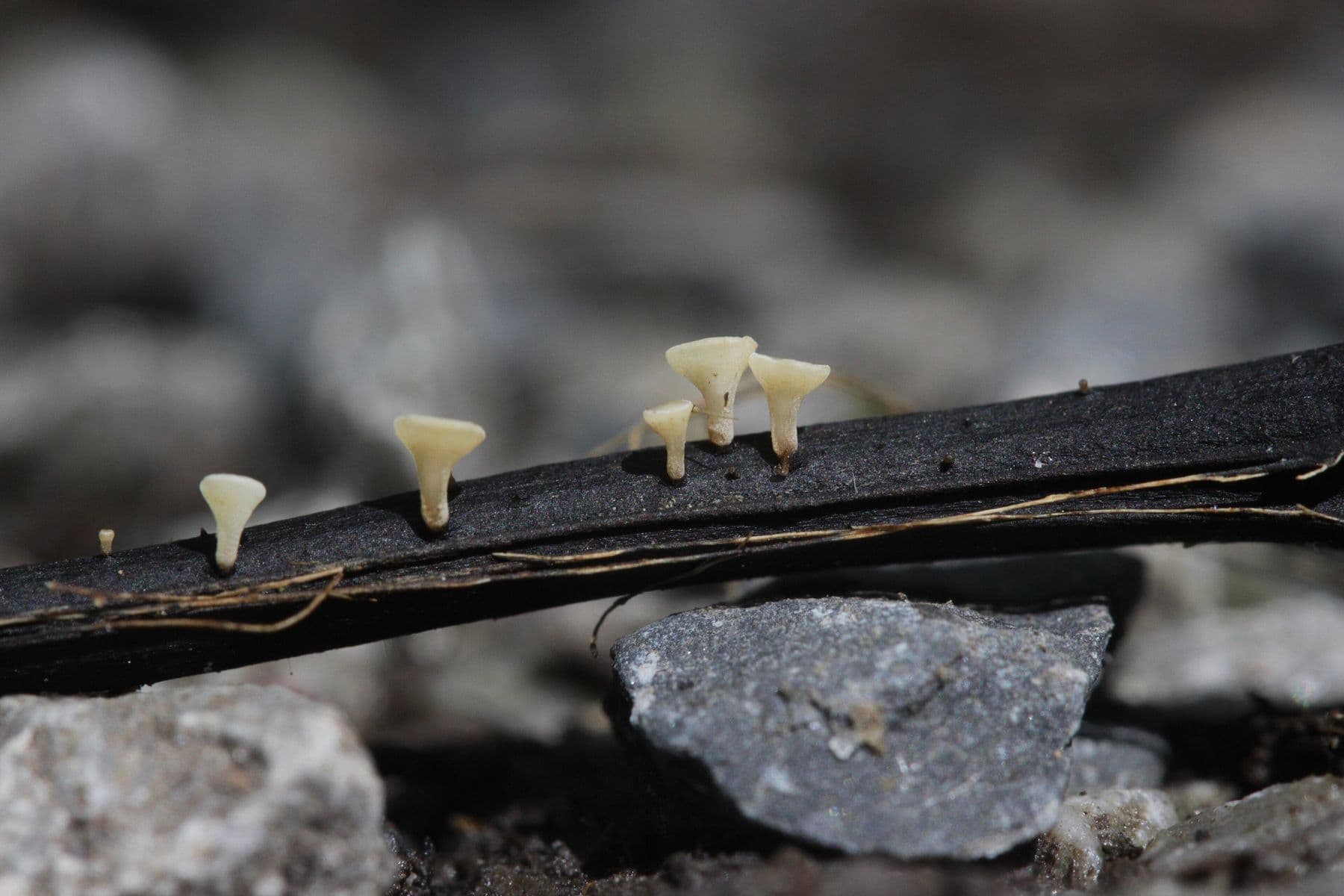
Fruiting bodies form on fallen leaf stalks
The fungus reproduces in the leaf litter. Tiny, white, mushroom-like fruiting bodies grow on the stalks of the previous year's fallen ash leaves.1
Step 2 of 4
Spores are released in summer
The fruiting bodies burst open to release thousands of spores, produced from June to September. Wind can carry them up to tens of miles, which is why the disease cannot be contained at a site boundary.1
Step 3 of 4
Leaves are infected first
Spores land on the leaves and bark of healthy trees. Most infected leaves are shed early. In some cases the infection moves on from the leaves into the twigs, the branches and eventually the trunk, where it forms dark lesions in the bark.1
Step 4 of 4
The tree is infected again each year
There is no known cure.6 The Woodland Trust's summary is that the tree can fight back, but year-on-year infections will eventually kill it.3 Young and coppiced ash are killed quite quickly. Older trees can resist for some time, until prolonged exposure or another pathogen such as honey fungus causes them to succumb.1
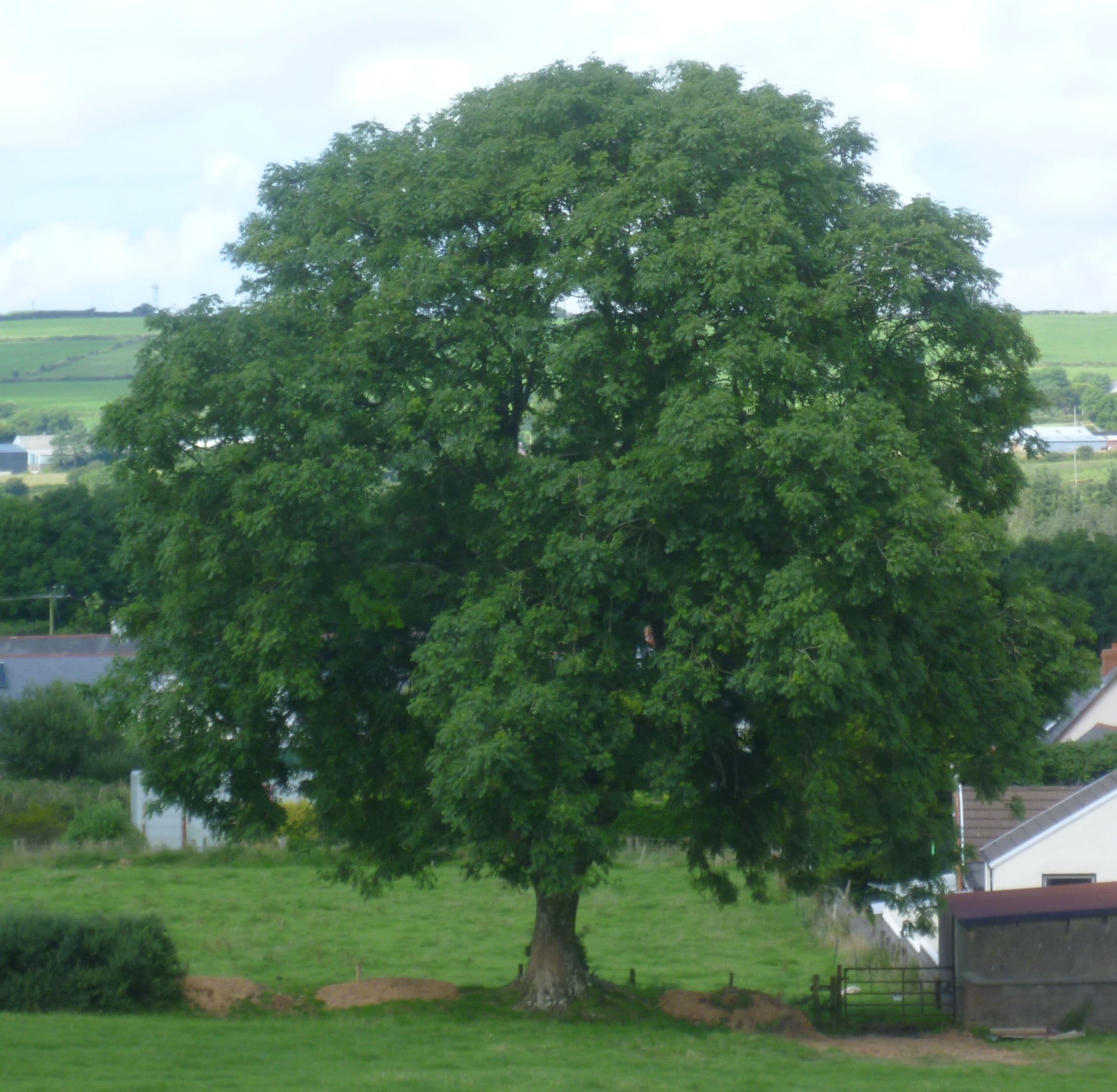
By mid-June all healthy ash should be in full leaf. That is the baseline every symptom is judged against.
Symptoms
Ash dieback symptoms, from leaf to root
The symptoms tend to appear in order: leaves and shoots first, then the bark, then the crown as a whole, and finally the base of the trunk. Select each point on the tree to follow them down.
1 of 5 · Leaves
Dark patches, then wilting and blackening
Leaves develop dark patches in summer, then wilt and discolour to black, and may be shed early. Forest Research lists blackening and wilting of leaves and shoots among the first symptoms of infection.
When to lookJuly to September. Once autumn begins, the normal seasonal change in leaf colour can be mistaken for the disease.
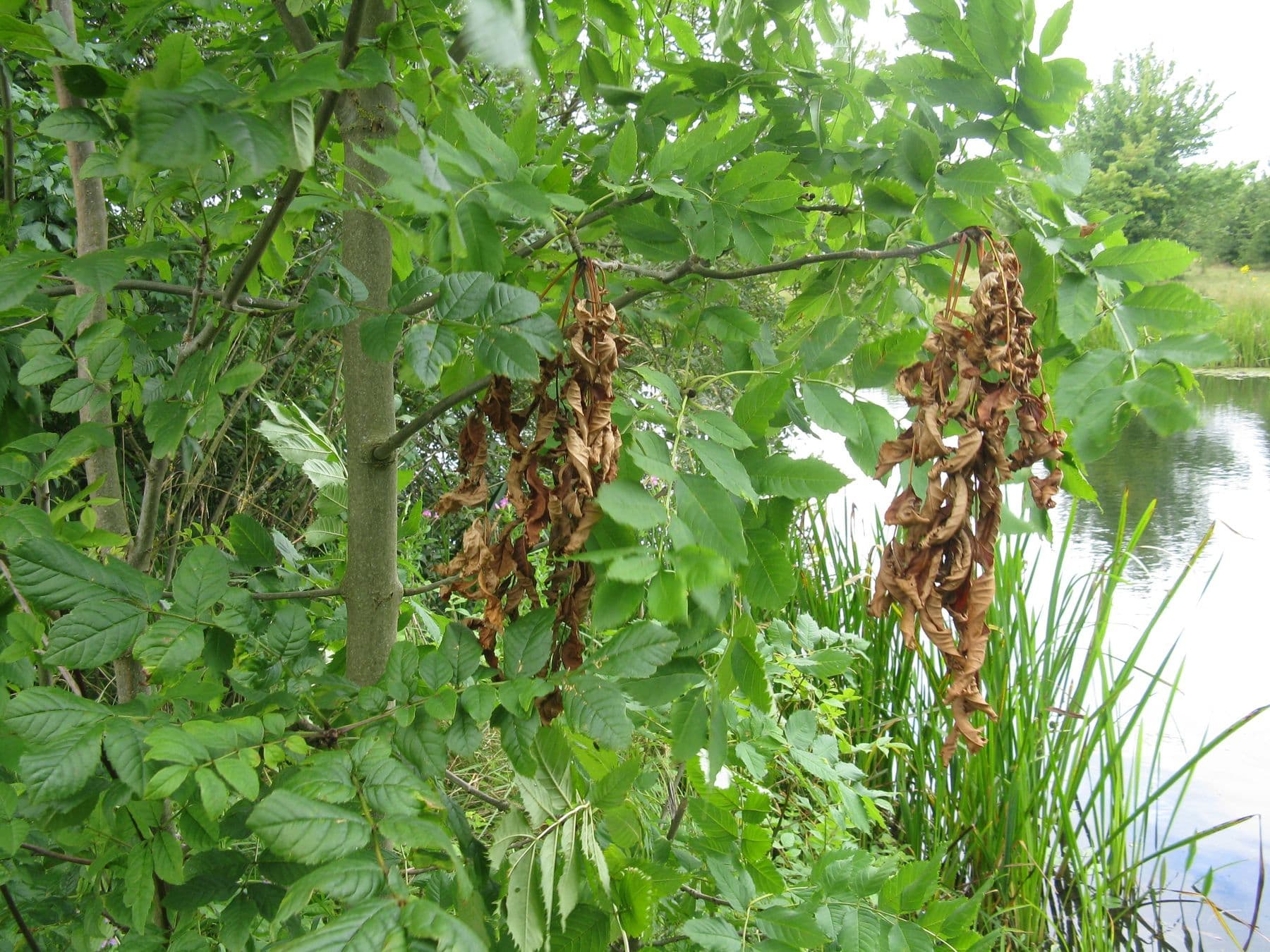
- Leaves: Dark patches, then wilting and blackening
- Leaves develop dark patches in summer, then wilt and discolour to black, and may be shed early. Forest Research lists blackening and wilting of leaves and shoots among the first symptoms of infection. July to September. Once autumn begins, the normal seasonal change in leaf colour can be mistaken for the disease.
- Shoots and crown edge: Dieback at the outside of the crown
- Mature trees first show dieback of the shoots and twigs at the edge of the crown, leaving bare tips above and around the foliage. Diseased saplings typically show dead tops or dead side shoots. Summer, when the tree should be in full leaf. By mid-June all healthy ash should be in full leaf.
- Bark: Diamond-shaped lesions where branches join
- Dark lesions form in the bark, often in an elongated diamond shape centred on the joint between branches or where a branch meets the trunk. A lesion can eventually girdle the stem and cut off the supply of fluid and nutrients from the roots. Bark lesions should be visible at any time of the year.
- Trunk and inner crown: Clumps of new growth lower down
- New shoots appear from previously dormant buds further down the trunk and towards the centre of the crown. This is epicormic growth, a common response to stress in trees, and it is seen alongside leaf loss and dead branches in the outer crown. Summer, when the dense clumps stand out against bare branch ends.
- Base of the trunk: Basal lesions and honey fungus
- Some trees develop dark lesions at the bottom of the trunk, sometimes with no leaf symptoms or lesions higher up. They can make the tree unstable, and they open the way to honey fungus, which Forest Research describes as often the ultimate cause of death, especially in older trees. Any time of year. A survey of the crown will not reveal them, so the base is inspected as well.
Symptom descriptions are drawn from Forest Research,1 the Woodland Trust,3 the Forestry Commission7, 2, 18 and the Royal Horticultural Society.8
What ash dieback is commonly mistaken for
The best time to survey is summer, when the symptoms are more obvious and the tree should have a full crown.17 Outside that window, and sometimes within it, four things account for most false alarms.
Late leafing
Ash is one of the last trees to come into leaf in spring. A bare ash in April or May is not necessarily diseased, but by mid-June all healthy ash should be in full leaf.1
Ash keys
Clumps of dark seeds stay on the tree after the leaves fall. This is normal, and from a distance they can be mistaken for blackened leaves.1
Drought and root problems
A thin crown is not proof of ash dieback. Drought stress, waterlogging, root damage and other pests and diseases also cause ash to decline.6
Insect damage
Browning of leaves in spring and early summer is very unlikely to be ash dieback and is frequently the result of insect damage.7
Stages
The four stages of ash dieback
Surveyors describe the progress of the disease in four ash health classes, based on how much of the crown remains. The Tree Council recommends them nationally for surveys.
88%
of the crown remaining
Class 1: most of the crown intact
Dieback, where it shows at all, is confined to the tips of the outer shoots. A tree in this class is normally kept on its usual inspection cycle and surveyed each summer in full leaf, so that change from one year to the next is recorded.
- Class 1 (100% to 76% of the crown remaining): most of the crown intact
- Dieback, where it shows at all, is confined to the tips of the outer shoots. A tree in this class is normally kept on its usual inspection cycle and surveyed each summer in full leaf, so that change from one year to the next is recorded.
- Class 2 (75% to 51% of the crown remaining): clear thinning and bare tips
- Gaps and bare shoot ends are visible across the crown in summer. The Tree Council records a mature tree losing 10% to 15% of its crown in a single season and notes that some decline much faster, so inspection becomes more frequent.
- Class 3 (50% to 26% of the crown remaining): half the crown or less
- The tree now relies heavily on regrowth further back on its branches and trunk. The Tree Council's advice to owners is to decide how a tree will be managed once it starts to look like class 3 or 4, usually with a qualified tree professional.
- Class 4 (25% to 0% of the crown remaining): little or no live crown
- The tree is dead or close to it. As ash declines it loses timber strength and becomes prone to structural failure, so a tree in this class that stands within falling distance of a road, a building or a well-used public space needs a decision without delay.
What the classes are for
The system was developed by Suffolk County Council in 2014 and scores the percentage of the crown that remains, as a proxy for the health of the tree.9 It is a way of sorting a population of trees so that attention goes where it is needed. It is not a felling rule, and no national guidance sets a class at which a tree must come down.
The Tree Council says as much: the system does not allow specific judgements about the safety of any individual tree, but it helps to identify trees that may need attention.5
What the classes cannot show
A full crown does not prove a sound tree. Basal lesions, and the root and butt rots that follow them, can destabilise a tree before the canopy has begun to decline.9
Decline is not steady either. Death has been observed in as little as two growing seasons,6 while some mature trees live with the disease for many years.5 A crown can even look better after a hot, dry summer while the tree continues to decline, which is why surveys are repeated every year.9
Public safety is the priority. The trees that matter most are those that can reach a road, a building or a path.
The owner's duty
What landowners have to do about ash dieback
There is no legal requirement to fell an ash because it is infected. The obligation is the one that comes with owning any tree: to take reasonable care that it does not injure anyone.
Forest Research states the position directly: an owner is not legally required to take any particular action over infected ash, unless a Statutory Plant Health Notice is served, which it describes as unlikely. Sightings need reporting only from parts of the country where the disease has not already been recorded.1 What the owner does have is a duty of care, and how much that duty asks depends on where the tree stands.
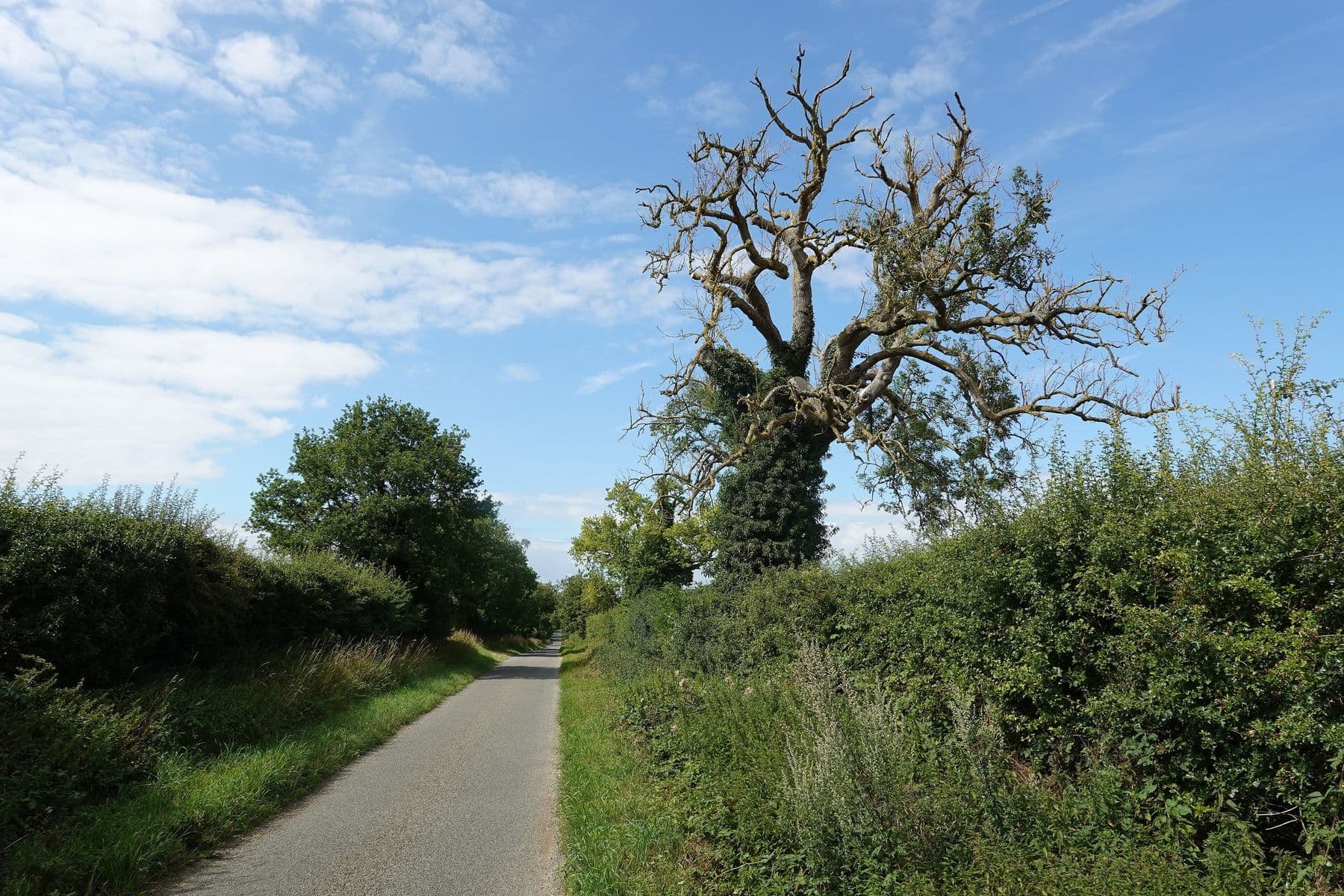
The highway authority can require the work, and give 14 days to do it
The Forestry Commission's guidance is that an owner's focus must be on ash growing in high risk locations, such as those next to highways, service network infrastructure and buildings, or in areas and routes frequently used by the public.6
Under section 154 of the Highways Act 1980, where a tree is dead, diseased, damaged or insecurely rooted and is likely to cause danger by falling on a highway, road or footpath, the authority may serve notice requiring the owner or occupier to cut or fell it within 14 days. If the notice is not complied with, the authority may carry out the work and recover its reasonable costs.10
The Tree Council advises contacting the local highway authority or Network Rail before any work on a roadside or railside tree.5
The duty is to take reasonable care, and to be able to show it
The government's guidance is that anyone managing ash near roads, railways, buildings and other publicly accessible land must consider the risks posed by infected ash and should carry out a risk assessment.2
The legal basis is the ordinary duty of an occupier. The Occupiers' Liability Act 1957 requires such care as is reasonable to see that a visitor will be reasonably safe,11 and the 1984 Act extends a duty to people other than visitors in some circumstances. The National Tree Safety Group describes the standard as that of the reasonable and prudent landowner, who is not expected to guarantee that a tree is safe.12
The owner is responsible, and pays for the work
The owner of land where a tree stands is legally responsible for the health and safety of those who could be affected by that tree.2 The Tree Council adds that it is the landowner's responsibility to fund the management of the trees on their property, and that an owner may be liable if a tree or branch falls on someone or on someone else's property.5
Trees standing in a garden are outside the felling licence requirement in England. Tree Preservation Orders, conservation area notice and wildlife law still apply.13
Where nobody is at risk, the advice is to keep the tree
Forest Research advises a general presumption against felling living ash, whether infected or not, except for public safety or timber production, because a small proportion will be able to tolerate the infection.1
The Tree Council's example is a tree in a hedge between two fields with no public access: where ash poses a low safety risk it should be left to decline naturally, so that it continues to benefit the environment.5 An ash that stands out as healthier than those around it should be retained where it is safe to do so.2
A written record is part of the duty
The Forestry Commission's advice is to keep written notes from monitoring, because they provide evidence of the owner's awareness of the risks and assessment of them should a tree fail and affect someone else.6 A dated survey each summer, with the class of each tree and the decision taken, is that record.
Before felling
Permissions to check before an ash is felled
Disease does not remove the need for permission. In England most felling of ash in response to dieback still needs a licence, and protected trees and wildlife are dealt with separately.
0 of 6 checks confirmed
Felling diseased ash requires a felling licence unless the trees are dead or pose a real and immediate danger.2 There is no general exception for diseased trees.13 Licences are free in England and are issued by the Forestry Commission.14
The exceptions are narrower than they sound. Up to 5 cubic metres may be felled in a calendar quarter without a licence, provided no more than 2 cubic metres are sold, and the danger exception applies only where there is an immediate risk of serious harm. In a prosecution for unlicensed felling, the burden of proving that an exception applied rests with the person who relied on it.13 Scotland and Wales regulate felling separately.
In England, the authority's consent is needed for work on a protected tree that is diseased or dying unless an exemption applies. A dead tree does not need consent, but five working days' written notice must be given before it is cut down. Where there is an immediate risk of serious harm, the urgent work may go ahead and notice is given as soon as practicable. In a conservation area, six weeks' notice is required before work on a tree.15
The Forestry Commission's position is that it is not always illegal to fell during the bird nesting season, but precautions must be taken by law.13 Our guide to the bird nesting season sets out the dates, the offences and what happens when a nest is found.
All bat species, their breeding sites and resting places are fully protected by law.16 If protected species are found while the work is under way, it must stop immediately.13 The Forestry Commission recommends carrying out wildlife surveys and obtaining permissions before trees become dangerous, in case urgent action is needed later.17
For a roadside or railside tree, the Tree Council's advice is to contact the local highway authority or Network Rail before undertaking any tree work.5 How the road is managed during the work shapes the method, the programme and the cost, so it is settled at the start.
Forest Research considers the spread of the disease in wood to be a low risk, so ash wood from infected sites may be moved without restriction within Great Britain. It strongly recommends brushing leaf and shoot material from logs, firewood and vehicles before they leave the site.18
Doing the work
Why infected ash is dismantled by machine
A declining ash cannot be relied on to behave like a healthy tree when it is climbed or felled. The safety guidance is consistent: do the work by machine wherever that is possible.
The Forestry Commission's explanation is that as an ash declines, and where it is affected by secondary pathogens, it appears to lose timber strength and integrity more rapidly and is prone to structural failure.6 Guidance produced by the Tree Council in 2025 adds that as the canopy declines, climbing with rope and harness cannot be recommended, because of the increased likelihood of anchor point failure.20
“…it is essential that every effort is made to fell these sites mechanically and to keep any chainsaw operations to an absolute minimum.”
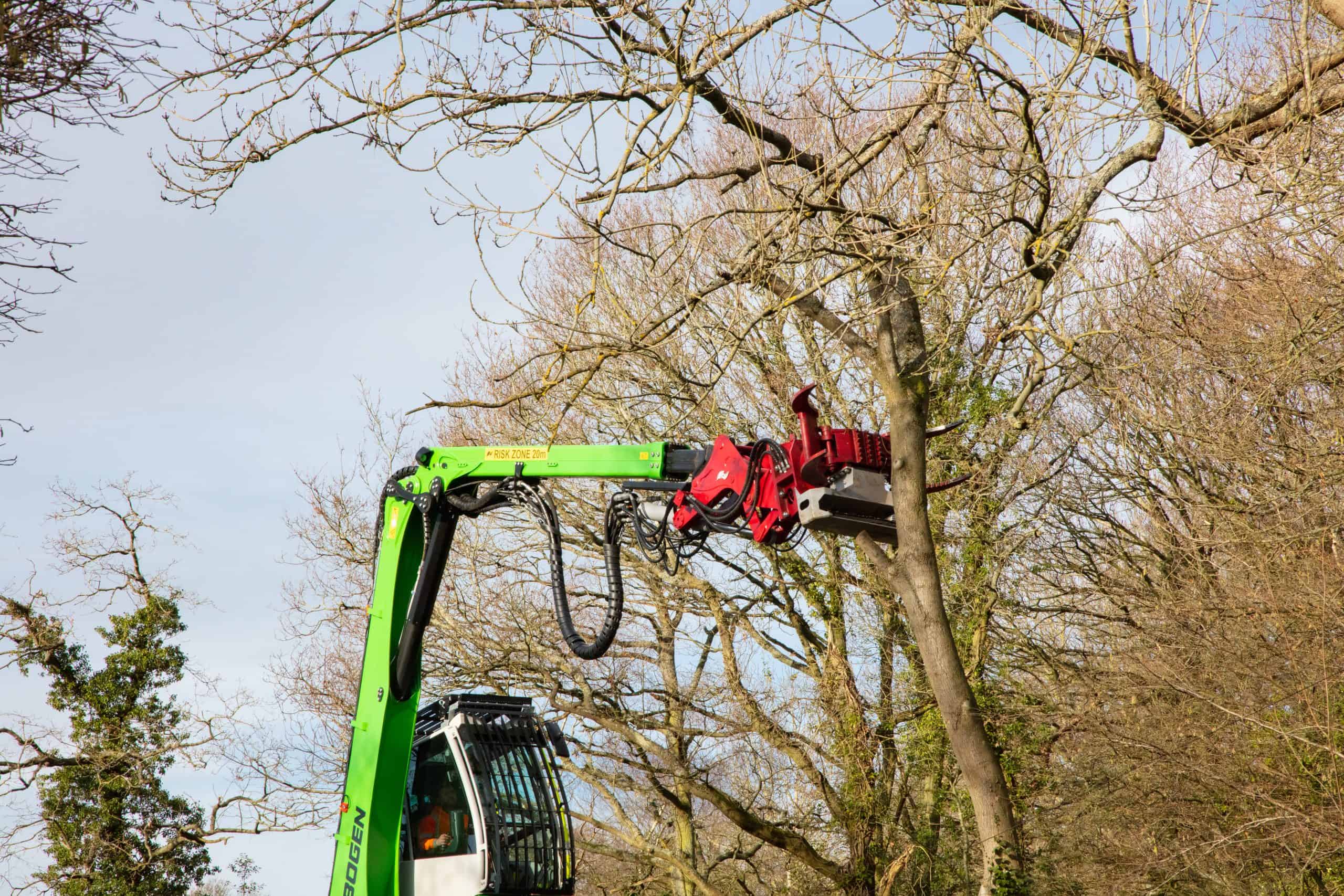
The Tree Council guidance names the machinery: cranes, grapple saws, harvesting heads and mobile elevated work platforms that protect the operator.20 The Arboricultural Association's practice guidance is to use a harvester or tree shear where practicable.21
Case study
Roadside ash removed without closing the road
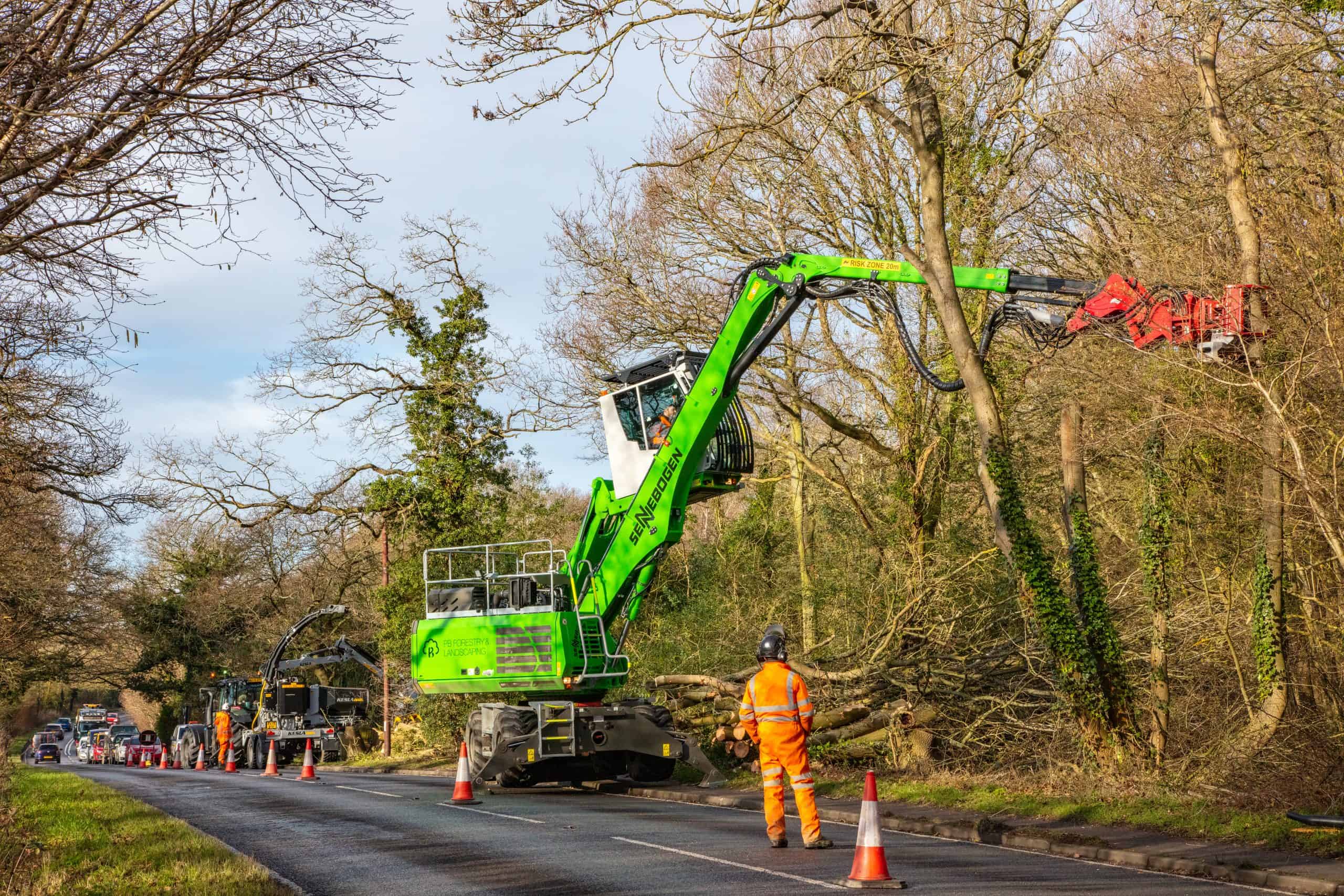
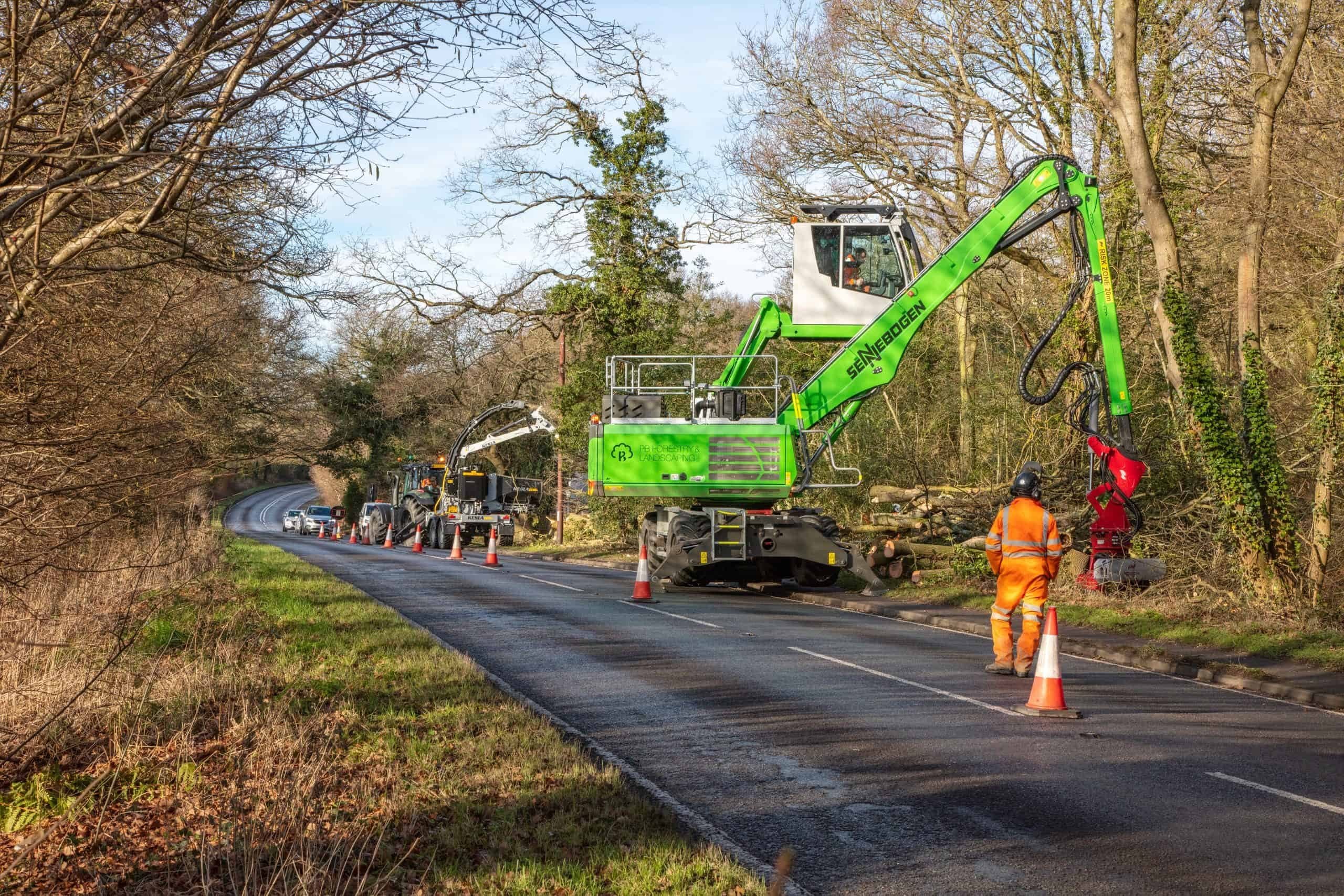
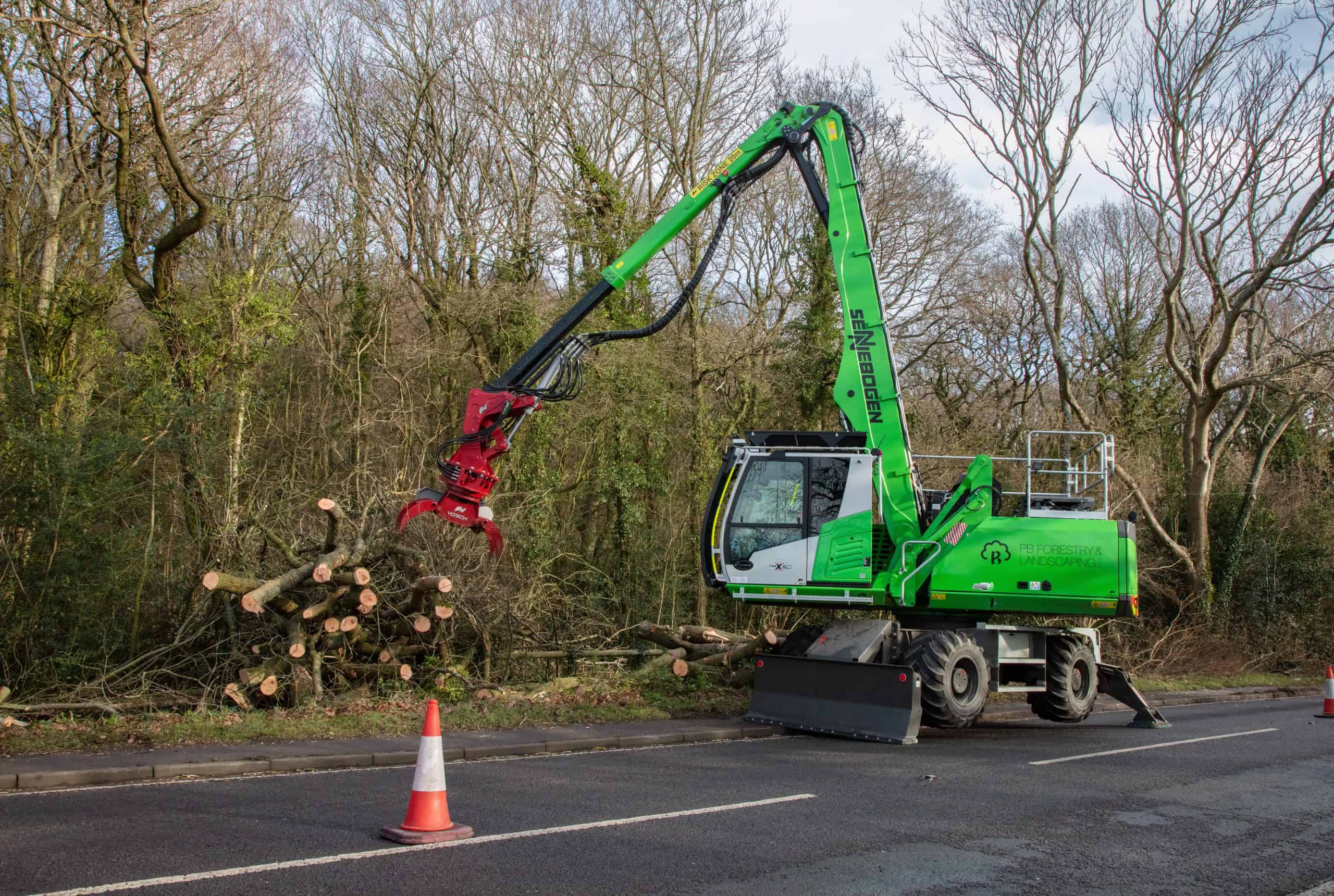
PB Forestry removed ash with advanced dieback along a 220m stretch of green space beside the A448, next to a public walkway and with a telecom cable running the length of the site. The trees overhung the carriageway.
The work was carried out with our Sennebogen 718 E-series and Kesla C645T2 chipper, without the need for manual chainsawing, to a bespoke set of risk assessments and method statements. It was completed in five days under a lane closure with traffic lights.
Read the ash dieback case studyWe were impressed with what could be achieved with the machinery used, which turned out to be the right bit of kit for the work. The operatives carried out an efficient and well controlled job and were able to do the work under a lane closure with traffic lights, which saved us the significant expense of a formal road closure.
After the trees come down
The government's guidance is that replacing trees felled because of ash dieback is important for minimising the impact of the disease, and that where large numbers are planted a range of appropriate species lowers the risk from future disease.2 The Forestry Commission puts it plainly: there is no single species that can be a replacement for ash.4
PB Forestry's planting service covers tree, hedge and shrub planting, including site reinstatement, and our article on mixed species planting explains why the mix matters.
Where PB Forestry come in
Removing diseased ash beside roads, paths and buildings is mechanical tree surgery: excavator mounted tree shears and grapple saws that take the tree down in sections with the operator in the cab. Where machinery is not suitable, our tree surgery teams use mobile platforms or rope access.
Discuss your treesThe short version
Ash dieback in six points
Ash dieback is caused by a fungus whose spores travel on the wind each summer. There is no cure, and it is present in most parts of the United Kingdom.
Symptoms run from blackened leaves and bare shoot tips, through diamond-shaped bark lesions, to lesions and honey fungus at the base of the trunk.
The four ash health classes record how much of the crown remains. They sort trees for attention and do not decide whether a tree is safe.
Nobody is required to fell an infected ash. Owners are required to take reasonable care, above all for trees that can reach a road, a building or a path.
In England diseased ash usually still needs a felling licence, and protected trees, nesting birds and bats are checked separately.
Declining ash is unpredictable to climb and to fell, so the guidance is to take it down by machine wherever possible.
Sources
This guide is general information and is not legal advice. Every statement of law or official guidance above is drawn from the sources listed here, last checked on 30 September 2026. Legislation and guidance change, so confirm the current position before relying on it.
- 1Forest Research, Ash dieback (Hymenoscyphus fraxineus)
- 2Forestry Commission, Managing ash dieback in England
- 3Woodland Trust, Ash dieback
- 4Forestry Commission, Operations Note 46: Managing ash in woodlands in light of ash dieback (2018)
- 5The Tree Council, Ash dieback disease: a guide for tree owners (2020)
- 6Forestry Commission, Operations Note 46a: Managing ash trees affected by ash dieback (2019)
- 7Forestry Commission, Chalara dieback of ash: symptoms guide
- 8Royal Horticultural Society, Ash dieback
- 9The Tree Council, Ash dieback: an action plan toolkit, version 2.0 (2019)
- 10legislation.gov.uk, Highways Act 1980, section 154
- 11legislation.gov.uk, Occupiers' Liability Act 1957, section 2
- 12National Tree Safety Group, Common sense risk management of trees, second edition (2024)
- 13Forestry Commission, Tree felling: getting permission
- 14Forestry Commission, When a felling licence is needed
- 15GOV.UK planning practice guidance, Tree Preservation Orders and trees in conservation areas
- 16Natural England and Defra, Bats: protection and licences
- 17Forestry Commission, Managing ash dieback in England, leaflet (2019)
- 18Forest Research, Chalara manual 2: Managing ash trees and woodland, including logs and firewood
- 19Forest Industry Safety Accord, Safety alert: Essential information on the felling of diseased ash (2020)
- 20The Tree Council for the Ash Dieback Risk Group (Scotland), Ash dieback: a supplementary guidance note for ash works in Scotland (2025)
- 21Arboricultural Association, Ash dieback: practice guidance
Photograph credits
- Small white fruiting bodies of Hymenoscyphus fraxineus on a blackened ash leaf stalk. Photo: Björn S., CC BY-SA 2.0, via Wikimedia Commons
- Mature ash tree in full leaf in July. Photo: Tony Holkham, CC BY-SA 4.0, via Wikimedia Commons
- Wilted, brown ash leaves hanging among healthy green foliage. Photo: M J Richardson, CC BY-SA 2.0, via Wikimedia Commons
- Field ash trees with thin crowns and bare outer shoots in summer. Photo: M J Richardson, CC BY-SA 2.0, via Wikimedia Commons
- Elongated lesion on an ash branch where the bark has dried and split open. Photo: Lamiot, CC BY-SA 4.0, via Wikimedia Commons
- Roadside ash with a bare outer crown and dense tufts of regrowth along its branches. Photo: M J Richardson, CC BY-SA 2.0, via Wikimedia Commons
- Ash tree with a largely dead crown standing over a hedged country road. Photo: Hugh Venables, CC BY-SA 2.0, via Wikimedia Commons
These photographs have been resized and cropped to fit the layout. All other photographs are PB Forestry's own.
Get in touch today
Companies we have worked with